



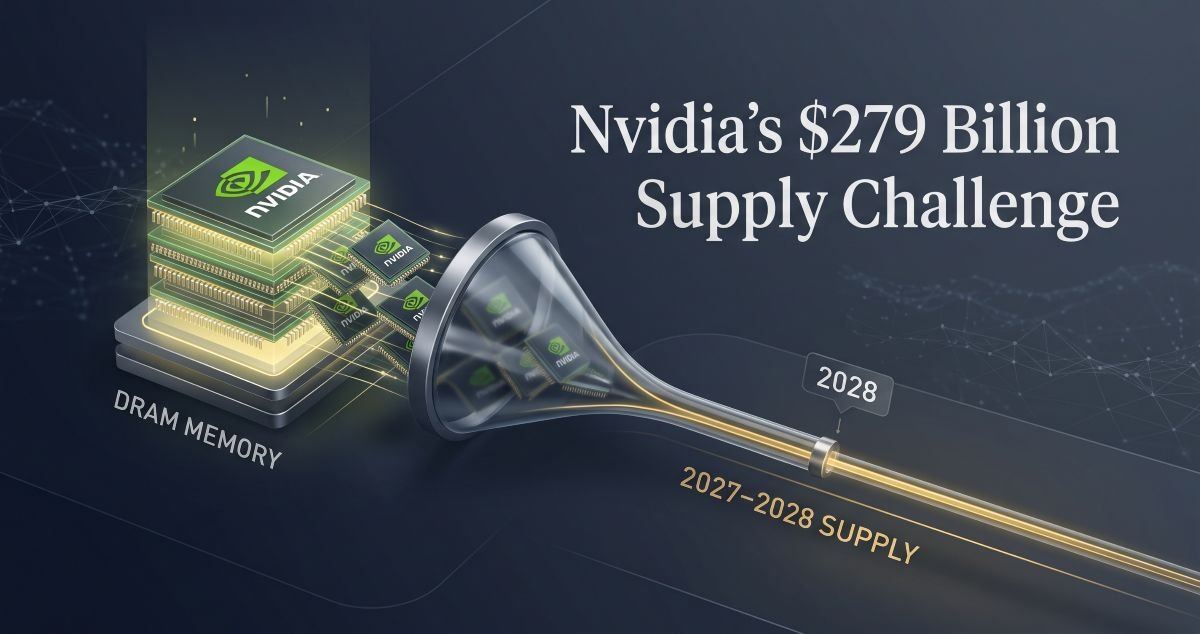
Anybody budgeting for AI infrastructure in 2027 is planning round a constraint that Nvidia says will final till at the least early 2028. On the US chipmaker’s August 26 earnings name, Chief Monetary Officer Colette Kress stated Nvidia expects “provide to stay a bottleneck” via at the least the top of its fiscal yr 2028, which closes in late January 2028. Its commitments, in the meantime, jumped from $119 billion to $279 billion in a single quarter, a rise the corporate’s CFO commentary calls “primarily associated to the procurement of reminiscence.”
Provide Stays Tight Till at Least Early 2028
Nvidia names its fiscal years for the calendar yr through which they finish, so fiscal 2028 runs from early 2027 to late January 2028. Kress known as the roughly 70% income development Nvidia expects for that yr a preliminary expectation and a “supply-constrained outlook.” Buyer forecasts level to development of about double, she stated, which leaves provide because the ceiling.
CEO Jensen Huang framed the hole this manner: demand is “a lot higher than 70%,” he instructed analysts, however provide “permits us to confidently ship 70%.” A Goldman Sachs analyst requested him to rank probably the most acute constraints, amongst them information heart and energy availability, DRAM and wafer foundry capability. Huang didn’t choose one. His reply was that “our whole provide chain is challenged.”
What the $279 Billion Comprises
The $279 billion is the availability and capability line in a desk of future commitments, as of July 26, that totals 366billion.Cloudserviceagreements(29 billion), information heart leases not but began (25billion),equityinvestments(25 billion) and capital expenditure ($8 billion) make up the remaining. Nvidia schedules the availability line by fiscal yr, and $267 billion of the $279 billion falls between the rest of fiscal 2027 and monetary 2029.
The reminiscence attribution covers the $160 billion improve, not the complete $279 billion. The commentary doesn’t break both determine down by part, so the reminiscence share of the full stays unknown. Kress stated reminiscence value will increase have “exceeded our prior expectations” and are “headed even larger into subsequent yr.”
Kress tied the margin reset to these prices. “Because of this, we’re resetting expectations at the moment,” she stated, and guided third-quarter gross margin to 74%, down from 75.0% within the second quarter. She expects margins to backside at 71% to 72% within the fourth quarter of fiscal 2027 earlier than settling at 72% to 73% in fiscal 2028 “as executed value will increase take impact in Q1.” The sequence suggests Nvidia expects to get well a part of the reminiscence invoice via its personal pricing.
Reminiscence Makers Describe the Identical Wall
Manish Bhatia, president and chief working officer of US reminiscence maker Micron, stated on the corporate’s September 30 analyst name that greater than 75% of its shipments for fiscal 2027 are dedicated, a yr that runs roughly from September 2026 to August 2027. He added that Micron has no “line of sight” to when provide and demand will stability. On October 28, Park Jun-deok, vice chairman in control of DRAM advertising and marketing at South Korea’s SK hynix, stated just about all the firm’s DRAM and high-bandwidth reminiscence quantity via 2029 is successfully offered out, as reported by South Korea’s Seoul Financial Each day.
Micron and Nvidia weigh the bottlenecks otherwise. Bhatia stated DRAM is “the principal constraint versus logic or energy to the info heart,” whereas Huang answered that the entire provide chain is challenged. SK hynix posted a report third-quarter working margin of 79.7%, which Chief Monetary Officer Kim Woo-hyun attributed to “larger product costs and expanded gross sales centered on high-value merchandise.” The implication is that reminiscence makers revenue from tight provide, so their outlooks are firm statements, not impartial measurements.
What Reminiscence Costs Do to Infrastructure Budgets
The US analysis agency Gartner forecast on October 21 that worldwide spending on information heart programs will rise 73.8% to $879 billion in 2026 and 55.5% to $1.366 trillion in 2027. It stated demand from information heart programs has pushed reminiscence costs to greater than double over the previous 12 months. Gartner analyst John-David Lovelock expects “memflation” to persist via 2027, and stated larger common promoting costs “proceed to assist spending development” whereas the stress on affordability is anticipated to suppress end-user demand. The discharge doesn’t separate how a lot of the expansion is value and the way a lot is quantity.
Contract phrases are already adjusting. On its March earnings name, the US server maker Hewlett Packard Enterprise disclosed that it had amended its quoting phrases to incorporate a proper to reprice current orders for commodity value will increase between quote and cargo. CEO Antonio Neri stated HPE expects elevated reminiscence and storage costs to persist nicely into 2027. HPE has additionally shortened its quote cycle and steers clients towards lower-memory configurations, Community World reported. For planners, an accredited quote might not match the ultimate bill, at the least with this vendor.
Startups and PC Consumers See the Squeeze Otherwise
Startups sit one step faraway from Nvidia’s cloud financing preparations. In line with the CFO commentary, Nvidia has partnered with AI clouds to serve startups, enterprises and different clients, incomes income on the upfront sale of its infrastructure and, if sure standards are met, a share of the clouds’ income from their very own clients. Kress instructed traders that Nvidia compute is “totally utilized throughout each cloud we serve.” The Wall Road Journal reported on August 27, citing individuals acquainted with the matter, that Nvidia had paused a few of these offers after workers raised considerations that the initiative may draw antitrust scrutiny. An Nvidia spokesperson stated the mannequin “remains to be in place and continues to evolve as a result of excessive demand.”
Client {hardware} reveals the stress too. Nvidia’s CFO commentary lists “slower client PC gross sales that had been tempered by elevated reminiscence and programs costs” as a drag on its edge computing income. The US analysis agency IDC’s preliminary information present third-quarter PC shipments fell 20.1% from a yr earlier to 62.7 million models. IDC’s Jitesh Ubrani blamed a part of the hunch on a first-half pull-in, as distributors and channels loaded up on stock early within the yr to get forward of value hikes. The US agency Jon Peddie Analysis gives the same principle for graphics playing cards, whose second-quarter shipments rose 10% from the prior quarter to 12.5 million: shoppers purchased earlier than costs climbed additional.
Nvidia stated on its August name that it’s going to focus on third-quarter fiscal 2027 outcomes on November 17. The commitments whole, the gross margin outlook after reminiscence value will increase and the preliminary 70% development expectation for fiscal 2028 will present whether or not the image Kress described in August nonetheless holds. Till then, alerts from Nvidia, Micron, SK hynix and Gartner recommend reminiscence provide and value will hold shaping AI infrastructure budgets into 2028.